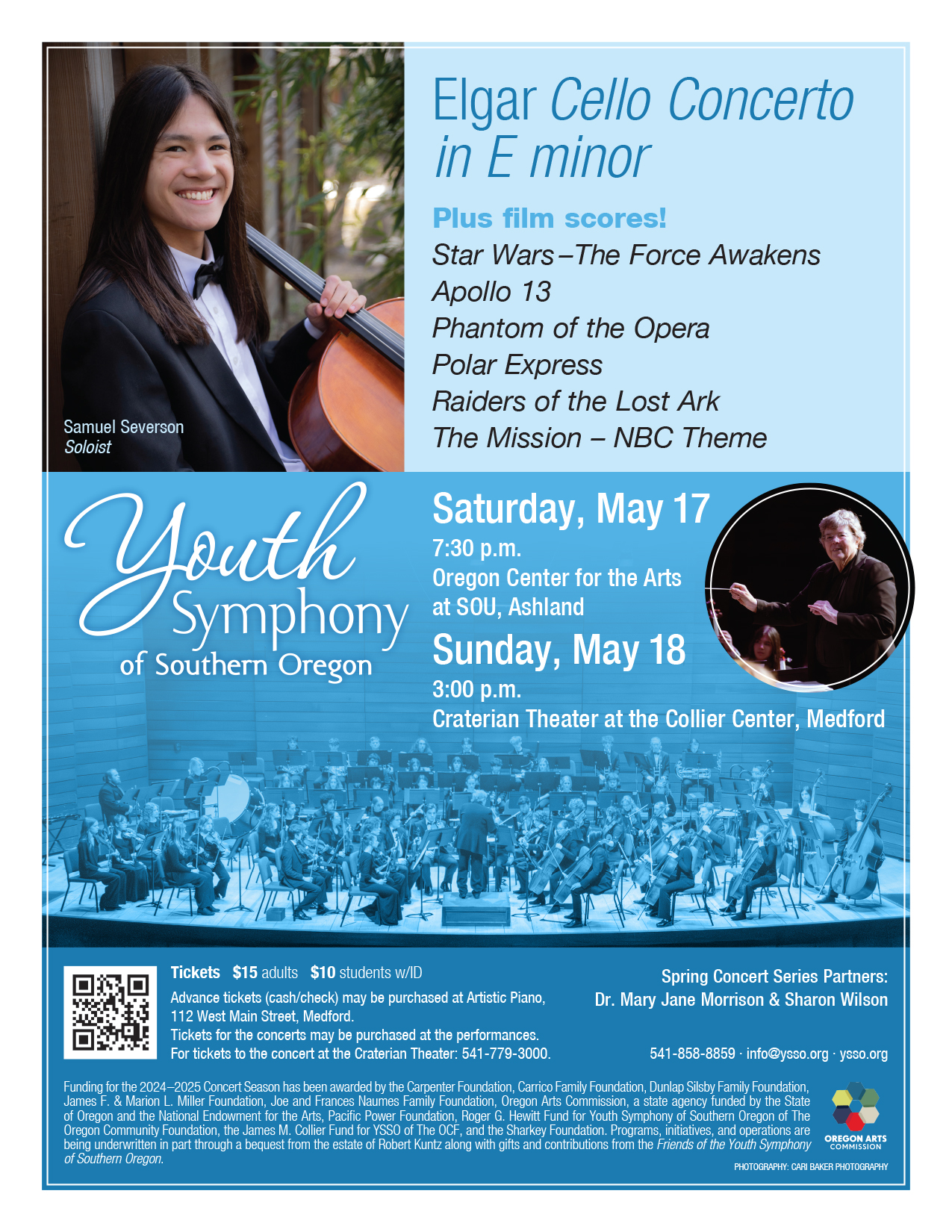
Spring Concert Series - May 22 & 23, 2010
Funding for Concert Series performances provided by:
Avista Utilities
Carpenter Foundation
City of Ashland
Dorothy F. Sherman Music Education Fund for Children
of The Oregon Community Foundation
Oregon Arts Commission
National Endowment
for the Arts
South Valley Bank & Trust
U.S. Bank
&
The Friends of the YSSO
Performances:
Saturday, May 22, 7:30 p.m.
SOU Music Recital Hall, Ashland
Sunday, May 23, 3:00 p.m.
Craterian Ginger Rogers Theater, Medford
Program:
Youth Symphony
Concerto in A minor for Oboe & Strings (mvts. 1 & 3) -
Ralph Vaughan Williams
Gabriel Young, oboe
Buckaroo Holiday, Saturday Night Waltz and Hoe-Down From the ballet Rodeo - Aaron Copland
Overture to The Cowboys -
John Williams
Youth Orchestra
Phantom of the Opera - Andrew Lloyd Webber
(arr. by Calvin Custer)
Robin Hood & His Merry Men - Erich Wolfgang Korngold (arr. by Roy Phillipe)
Prelude to Carmen - Georges Bizet
(arr. by Casey Kriechbaum)
Youth Strings
Bourée-
George Frideric Händel
Minuet in G - Ludwig van Beethoven
Hunter’s Chorus -
Carl Maria von Weber
Takataka Concerto in A -
Judy Weigert Bossuat
Gabriel Young, oboe
Ashland Middle School (AMS) student Gabriel (Gabe) Young, was selected as one of the winners of the Youth Symphony of Southern Oregon’s 2010 Concerto Competition. Principal Oboe of Youth Symphony, he has participated in the YSSO for three years. He studies oboe privately with Kenton Gould. A versatile multi-instrumentalist, Gabe has studied saxophone with Rhett Bender, Daryl Fjeldheim, Jan Christensen and Dennis Freese, as well as piano with Dave Scoggin and percussion with Tom Freeman. He also plays flute and clarinet. His school music teachers have included David Mann, Jenifer Carstensen, Louis Leger and Janet Davis.
Gabe has performed with numerous community groups, bands and at festivals, including the AMS Concert Band, AMS Jazz Band, Southern Oregon Jazz Orchestra, Temple Klezmer Orchestra, Bar Misfits Klezmer Band, Salsa Brava and the Rogue Valley Blues Festival, to name a few. He is well-known to audiences throughout the region for his work with Gabe Young and Friends, Jerry Attrick & the Pacemakers, the Young Family Trio and Two Young Men. In addition, Gabe has participated in the Britt Institute Instrumental Jazz Camp and the University of Oregon Improvisational Jazz Camp, and in master classes led by George Young and Paul McCandless.
From a family of gifted musicians, Gabe has been immersed in music throughout his life. He observed, “Before I developed my own musical identity, I was nurtured through my family’s music. Being raised in a loving, supportive, musical community has really helped my growth.” He cites the jazz greats as offering both inspiration and motivation. He counts his sister and father as music mentors. Gabe shared, “It’s a great thing to be able to share the music I love with the people I love.” He went on to say, “We play together; we perform together; we support each other musically.”
Among his many honors, Gabe was selected to participate in the 2010 Oregon Music Educators Association All-State Middle School Honor Band (oboe). He was named Most Valuable Player (saxophone) at the 2009 Britt Jazz Camp and received both the Top Saxophonist and Outstanding Music Theory Student awards at the 2009 University of Oregon Summer Improvisational Jazz Camp.
Youth Orchestra
Phantom of the Opera (selections)
Andrew Lloyd Webber
Webber started composing at the age of six, and was published at age nine. Educated at Oxford University, he would go on to compose thirteen musicals for London’s West End and Broadway. Among the most loved in the genre, they include Joseph and the Amazing Technicolor Dreamcoat (1968), Jesus Christ Superstar (1970), Evita (1976), Cats (1981) and The Phantom of the Opera (1986).
Knighted in 1992 and created an honorary life peer in 1997, Andrew Lloyd Webber is Baron Lloyd-Webber, of Sydmonton, in Hampshire. He is also the recipient of many awards, including six Tony Awards, three Grammy Awards, a Golden Globe and an Oscar®.
Phantom of the Opera is based on the 1909 novel Le Fantôme de l'Opéra by Gaston Leroux. It was made into a popular silent movie in 1925. The story takes place from 1881 to 1891 behind the scenes at the Paris Opera house. A mysterious presence in the opera house, the phantom of the opera, becomes infatuated with Christine, a young soprano who sings in the chorus. The phantom is in reality Erik, a disfigured musical genius who was on the crew that constructed the opera house. He has been living hidden away in the opera house ever since.
Among the most beloved musicals in the history of the genre, Phantom is also one of the longest-running shows. The stars Sarah Brightman (Christine) and Michael Crawford (the Phantom) were members of the original Broadway cast. Still running, as of April 18, 2010, it is the longest running musical in Broadway history with 9,243 performances. The second longest-running show on Broadway is Webber’s Cats with a total of 7,485 performances from 1982 to 2000.
Phantom is a show within a show: a story of obsession within the larger framework of the opera company. Phantom’s musical score acknowledges this by presenting us with music from both worlds: modern musical comedy and opera. He has said that the show’s title song is “Rock n’ Roll merely masquerading as opera.” Different characters are given their own musical treatments: the central characters are depicted in a more natural modern way, while supporting characters inhabit the world of opera. Some of the best known songs from the show include “Think of Me,” “The Music of the Night” and “All I Ask of You.”
Robin Hood & His Merry Men
Erich Wolfgang Korngold
Born in Brünn, Austria, the second son of music critic Julius Korngold, Erich showed a strong talent for music as a child. Upon hearing his compositions at age nine, Gustav Mahler declared him a “musical genius.” His pantomime Der Schneemann (The Snowman) was performed at the Vienna Court Opera when he was eleven years old. After an initial flurry of successes, his more mature works failed to receive as much recognition.
In 1934, Korngold was invited to come to Hollywood to adapt Mendelssohn’s incidental music for A Midsummer Night’s Dream for film. A subsequent trip to California took place in 1938 when Korngold was invited to write the score for the film The Adventures of Robin Hood starring Errol Flynn, Olivia de Havilland, Basil Rathbone and Claude Rains. This high-budget Technicolor® film was a vibrant swashbuckling adventure-romance story. Korngold’s music expanded the depth of the film’s storytelling tremendously.
While he was in Hollywood, Germany invaded Austria. With living conditions at home becoming more and more precarious, Korngold elected to remain in the United States. He would later say that Robin Hood saved his life.
Korngold won an Oscar® for “Best Original Score” for The Adventures of Robin Hood. He became one of the pioneers of film music in the United States and the world. His concept of treating the film like an “opera without singing” would prove to be seminal. Each character or situation has a unique and easily recognizable leitmotif; a theme to represent what the audience is seeing in musical terms. In this way, Korngold’s film scores advance and deepen the story. At the same time, this technique ensures a musically satisfying composition, allowing the music to be heard and enjoyed on its own terms in the concert hall.
Since American films were not shown in Germany and Austria in the Nazi times, many Germans were unfamiliar with them until they were subsequently shown on television there starting in the 1950’s. For broadcast, the soundtracks of these films were usually discarded and replaced with over-dubbed dialogue in German and “stock” music. Ironically, Korngold’s scores to these films were largely unknown, at least in their filmic context, in his native country. This was remedied on November 25, 2007, with a presentation of the original uncut, un-dubbed Adventures of Robin Hood in Vienna, 71 years after its initial release.
At the time of his death his music largely was considered old-fashioned. Today, his compositions are enjoying a renaissance of renewed interest.
Georges Bizet
Prelude to Carmen
Georges Bizet was born in 1838 and his death in 1875 at age 36 was nothing less than a tragedy. His final work was the opera Carmen which he composed in the years 1873 and 1874. The opera premiered at the Opéra Comique in Paris on March 3, 1875, a date which should have been a red letter day for Bizet. That morning, he had been appointed Chevalier of the French Legion of Honor and the rehearsals for Carmen had gone well. Unfortunately, from the premiere to well after his death on June 3 of the same year, the opera was considered a failure, being characterized as trivial and immoral. The audience was shocked and puzzled by what they saw and heard, although they did not greet the work with hostility as is often averred. Today, of course, it is considered one of the best-loved operas of all time. OPERA America ranks it as the fourth most performed opera in North America.
The opera is set in Seville, Spain circa 1820, and concerns the tragic fate of the hot-blooded gypsy Carmen. It is the only opera by Bizet consistently staged today. Among the most popular pieces from the opera are the “Habanera,” the “Toreador Song” and the “Prelude” (overture). When asked if he would visit Spain to do research for composing Carmen, Bizet replied, “No, that would just confuse me.” Despite this, Bizet successfully brought elements of Spanish music to the score.
Although Bizet preferred to create new material for each scene in the opera, there are a few themes or leitmotifs that permeate the score, one of which, the “Carmen Fate” motif, starts the Prelude in the Orchestral Suite No. 1. Its augmented seconds are characteristic of Spanish music and the Arabic music that informed music in the Middle Ages. In the opera itself, the “Prelude” begins with the march of the toreadors.
Youth Symphony
Concerto in A Minor for Oboe & Strings
Ralph Vaughan Williams
Ralph Vaughan Williams completed his oboe concerto in 1944 on a commission from the oboist Léon Goossens. A respected soloist, teacher and a founding member of the London Philharmonic Orchestra under Sir Thomas Beecham, Goossens also commissioned oboe works from composers Edward Elgar (Soliloquy, 1930) and Rutland Boughton (one of his two oboe concertos).
Because of the threat of V1 rocket attacks in London in 1944, the premiere of Vaughan Williams’ concerto was held in Goossens’ home town of Liverpool on September 30 of the same year. It had been intended for the Proms concerts in London’s Royal Albert Hall.
Vaughan Williams completed his Fifth Symphony shortly before beginning work on the concerto. Some themes that he wrote and did not use in the symphony are incorporated into the concerto.
We will hear the first movement, Rondo Pastorale, and the third, Scherzo. In the first movement, one can initially imagine a solitary shepherd playing music for his own enjoyment in the wilderness. A lively dance theme ensues with contrapuntal imitation in the strings. The return of the first theme brings a rich sensation of return, followed by a short cadenza, and a plaintive conclusion. Like the first movement, the finale is cast in a ternary form. The central contrasting theme is harmonically lush and emotionally nostalgic. The brisk theme that precedes and follows it ultimately flows into a joyous and quick waltz. The work concludes with a slow coda. The concerto starts and ends with the same three quiet chords in the strings.
The concerto is pastoral in tone, often contemplative and nostalgic. The work’s delightful “listenability” disguises some very challenging passages for both the soloist and the string orchestra. A warm modal neo-classicism pervades the work, which finds significant contrast in sections characterized by extreme chromaticism and dissonance.
Rodeo
Aaron Copland
Rodeo, a ballet in one act with music by Aaron Copland and choreography by Agnes de Mille, premiered at the Metropolitan Opera House in New York on October 16, 1942, with de Mille dancing the lead roll of the cowgirl. Rodeo was Copland’s second “cowboy” ballet score, following Billy the Kid. Broadway luminaries Richard Rodgers and Oscar Hammerstein attended the premiere and thereupon asked de Mille to choreograph their upcoming musical, Oklahoma! which would open the following year.
Copland makes use of direct quotations of several American folk tunes in Rodeo, including Bonaparte’s Retreat, McLeod’s Reel, Sis Joe, Old Paint and others. Unlike other uses of folk material in Copland’s music, these references are largely intact and unaltered. This may be due in part to the fact that de Mille had blocked out the entire ballet to these melodies before Copland began his work!
The story of the ballet, conceived by choreographer de Mille, focuses on the cowgirl who, though a tomboy at heart, wants to attract the attention of the head wrangler. Some elements of the ballet are autobiographical snapshots of de Mille.
For the symphonic suite Four Dance Episodes from Rodeo, Copland removed the third of the five pieces in the ballet score (Ranch House Party) and made some other nips and tucks for a total of about five minutes of music. One notable omission was a piano solo said to have been composed by a young Leonard Bernstein as a gift to his mentor Copland. Bernstein also contributed music to the Choral Nocturne movement. With enhanced orchestration, the work now resembled a symphony in form with an allegro first movement, slow second movement, a minuet, and a rip-roaring finale. The suite was premiered by the Boston Pops Orchestra in 1943 and still enjoys success on concert stages all over the world.
Overture to The Cowboys
John Williams
If you were lucky enough to see director Mark Rydell’s movie The Cowboys when it was released in 1972, you would have enjoyed a visual and musical treat. John Williams’ score to this stunningly beautiful film, written in the “pre-Star Wars” days, advanced the story of the movie by presenting the excitement, nostalgia, and strong emotions of the characters and the setting. Many consider it to be one of the last of the great Westerns. It certainly was one of John Wayne’s last films, his last being The Shootist in 1976.
In addition to the incidental music, the audience was given an overture, an entr’acte, and exit music. These pieces were heard in the darkened theater before and after the film (not over the credits) and during an intermission, in the manner of an opera performance.
Although the dramatic connection between the action and the music is not as formal as Korngold’s “Opera without Singing” technique, the music creates the same kind of emotional and dramatic context. No leitmotif was assigned to any one particular element of the drama, but rather a musical fabric was created that echoed the action on screen and enhanced it.
Program Notes by Dr. Mark E. Jacobs